Words With the Root Re Meaning Again
Morphology is the study of words and their parts. Morphemes, similar prefixes, suffixes and base words, are defined equally the smallest meaningful units of meaning. Morphemes are of import for phonics in both reading and spelling, as well as in vocabulary and comprehension.
Why utilize morphology
Didactics morphemes unlocks the structures and meanings within words. It is very useful to take a strong awareness of prefixes, suffixes and base of operations words. These are oft spelt the aforementioned across dissimilar words, even when the sound changes, and oftentimes accept a consequent purpose and/or meaning.
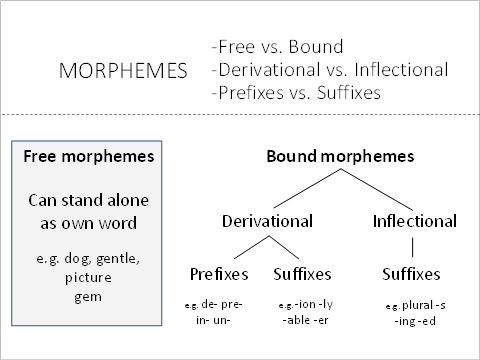
Types of morphemes
Free vs. bound
Morphemes can be either single words (free morphemes) or parts of words (bound morphemes).
A free morpheme tin can stand up alone as its ain discussion
- gentle
- begetter
- licence
- picture
- jewel
A spring morpheme just occurs as office of a word
- -s as in cat+s
- -ed as in crumb+ed
- un- as in un+happy
- mis- as in mis-fortune
- -er as in teach+er
In the example higher up: united nations+system+atic+al+ly, there is a root word (system) and bound morphemes that attach to the root (un-, -atic, -al, -ly)
system = root united nations-, -atic, -al, -ly = bound morphemes
If two free morphemes are joined together they create a compound give-and-take. These words are a great mode to introduce morphology (the study of word parts) into the classroom.
For more details, come across: Compound words
Inflectional vs. derivational
Morphemes tin can as well be divided into inflectional or derivational morphemes.
Inflectional morphemes change what a word does in terms of grammar, but does not create a new word.
For example, the discussion <skip> has many forms: skip (base grade), skipping (present progressive), skipped (past tense).
The inflectional morphemes -ing and -ed are added to the base of operations word skip, to indicate the tense of the give-and-take.
If a discussion has an inflectional morpheme, it is still the same word, with a few suffixes added. Then if you looked up <skip> in the dictionary, then only the base word <skip> would get its own entry into the dictionary. Skipping and skipped are listed nether skip, as they are inflections of the base word. Skipping and skipped do not get their own dictionary entry.
Skip
verb, skipped, skipping.
- to motion in a light, springy way past bounding forward with alternate hops on each foot. to pass from one point, thing, subject, etc.,
- to another, disregarding or omitting what intervenes: He skipped through the book quickly.
- to go abroad hastily and secretly; flee without notice.
From Dictionary.com - skip
Another case is <run>: run (base of operations grade), running (nowadays progressive), ran (by tense). In this example the by tense marker changes the vowel of the discussion: run (rhymes with fun), to ran (rhymes with can). Nonetheless, the inflectional morphemes -ing and past tense morpheme are added to the base word <run>, and are listed in the same dictionary entry.
Run
verb, ran, run, running.
- to go speedily past moving the legs more rapidly than at a walk and in such a manner that for an instant in each step all or both feet are off the basis.
- to motion with haste; act quickly: Run upstairs and become the iodine.
- to depart quickly; take to flight; flee or escape: to run from danger.
From Dictionary.com - run
Derivational morphemes are different to inflectional morphemes, as they do derive/create a new word, which gets its own entry in the dictionary. Derivational morphemes help us to create new words out of base words.
For instance, nosotros can create new words from <act> past adding derivational prefixes (e.g. re- en-) and suffixes (due east.g. -or).
Thus out of <act> we can get re+act = react en+deed = enact act+or = actor.
Whenever a derivational morpheme is added, a new discussion (and dictionary entry) is derived/created.
For the <human action> example, the following lexicon entries can exist found:
Human action
noun
- anything washed, being done, or to be done; deed; performance: a heroic act.
- the process of doing: caught in the act.
- a formal decision, law, or the like, by a legislature, ruler, court, or other authority; decree or edict; statute; judgement, resolve, or honour: an act of Parliament.
From Dictionary.com - deed
React
verb
- to human action in response to an agent or influence: How did the audition react to the speech?
- to act reciprocally upon each other, as ii things.
- to act in a reverse direction or mode, especially so as to return to a prior condition.
From Dictionary.com - react
Enact
verb
- to make into an act or statute: Parliament has enacted a new revenue enhancement police.
- to represent on or equally on the stage; deed the part of: to enact Hamlet.
From Dictionary.com - enact
Role player
substantive
- a person who acts in stage plays, movement pictures, television set broadcasts, etc.
- a person who does something; participant.
From Dictionary.com - histrion
Teachers should highlight and encourage students to analyse both Inflectional and Derivational morphemes when focussing on phonics, vocabulary, and comprehension.
For more information, run into:
Prefixes, suffixes, and roots/bases
Many morphemes are very helpful for analysing unfamiliar words. Morphemes can be divided into prefixes, suffixes, and roots/bases.
- Prefixes are morphemes that adhere to the front end of a root/base of operations word.
- Suffixes are morphemes that attach to the terminate of a root/base word, or to other suffixes (see case below)
- Roots/Base words are morphemes that form the base of operations of a word, and usually conduct its meaning.
- Generally, base words are free morphemes, that can stand past themselves (due east.g. wheel as in bicycle/cyclist, and form as in transform/formation).
- Whereas root words are spring morphemes that cannot stand by themselves (e.g. -ject every bit in subject area/reject, and -volve equally in evolve/revolve).
Most morphemes can be divided into:
- Anglo-Saxon Morphemes (like re-, un-, and -ness);
- Latin Morphemes (like non-, ex-, -ion, and -ify); and
- Greek Morphemes (similar micro, photo, graph).
It is useful to highlight how words can exist cleaved down into morphemes (and which each of these hateful) and how they tin be built up again).
For example, the word <unreliability> may be unfamiliar to students when they starting time meet information technology.
If <unreliability> is broken into its morphemes, students can deduce or infer the meaning.
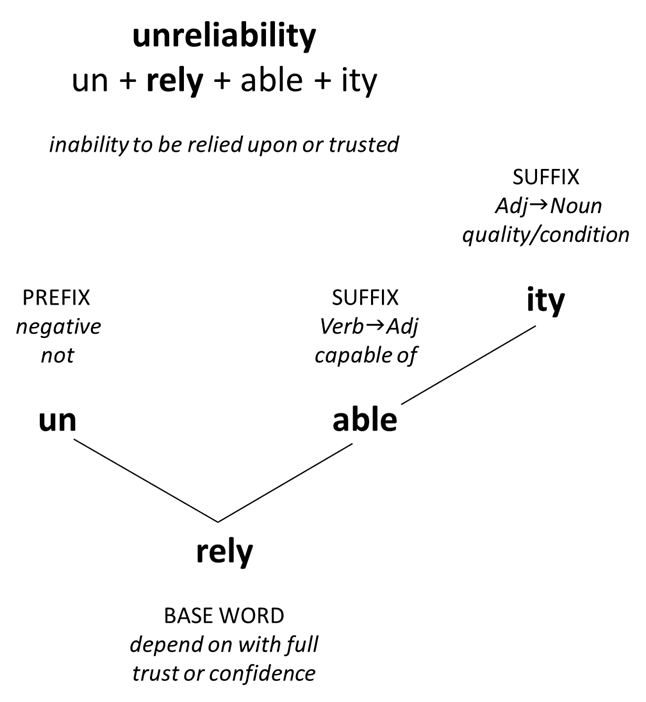
So it is helpful for both reading and spelling to provide opportunities to analyse words, and go familiar with common morphemes, including their meaning and function.
Chemical compound words
Compound words (or compounds) are created past joining free morphemes together. Remember that a costless morpheme is a morpheme that can stand up forth equally its own word (unlike bound morphemes - e.g. -ly, -ed, re-, pre-). Compounds are a fun and attainable fashion to innovate the idea that words tin have multiple parts (morphemes). Teachers tin highlight that these compound words are made upwardly of ii divide words joined together to make a new word. For case canis familiaris + house = doghouse
Examples
- lifetime
- basketball
- cannot
- fireworks
- within
- upside
- footpath
- sunflower
- moonlight
- school
- railroad
- skateboard
- meantime
- featherbed
- sometimes
- airport
- butterflies
- grasshopper
- fireflies
- footprint
- something
- homemade
- backbone
- passport
- upstream
- spearmint
- earthquake
- backward
- football
- scapegoat
- eyeball
- afternoon
- sandstone
- meanwhile
- limestone
- keyboard
- seashore
- touchdown
- alongside
- subway
- toothpaste
- silversmith
- nearby
- raincheck
- blacksmith
- headquarters
- lukewarm
- cloak-and-dagger
- horseback
- toothpick
- honeymoon
- bootstrap
- township
- dishwasher
- household
- weekend
- popcorn
- riverbank
- pickup
- bookcase
- babysitter
- bucket
- bluefish
- hamburger
- honeydew
- thunderstorm
- spokesperson
- widespread
- hometown
- commonplace
- supermarket
Instance activities of highlighting morphemes for phonics, vocabulary, and comprehension
There are numerous ways to highlight morphemes for the purpose of phonics, vocabulary and comprehension activities and lessons.
Highlighting the morphology of words is useful for explaining phonics patterns (graphemes) and spelling rules, as well as discovering the meanings of unfamiliar words, and demonstrating how words are linked together. Highlighting and analysing morphemes is too useful, therefore, for providing comprehension strategies.
Examples of how to embed morphological sensation into literacy activities can include:
- Sorting words by base/root words (word families), or by prefixes or suffixes
- Word Detective - Students intermission longer words downward into their prefixes, suffixes, and base of operations words
- east.chiliad. Find the morphemes in multi-morphemic words like: dissatisfied unstoppable ridiculously hydrophobic metamorphosis oxygenate fortifications
- Word Builder - students are given base words and prefixes/suffixes and see how many words they can build, and what meaning they might have:
- Prefixes: un- de- pre- re- co- con-
Base Words: play help flex bend blue lamentable sat
Suffixes: -ful -ly -less -able/-ible -ing -ion -y -ish -ness -ment - Etymology investigation - students are given multi-morphemic words from texts they have been reading and are asked to research the origins (etymology) of the discussion. Teachers could use words like progressive, attentive, revocation, and students could find out the morphemes within each word, their etymology, meanings, and utilise.
Source: https://www.education.vic.gov.au/school/teachers/teachingresources/discipline/english/literacy/readingviewing/Pages/litfocuswordmorph.aspx
0 Response to "Words With the Root Re Meaning Again"
Post a Comment